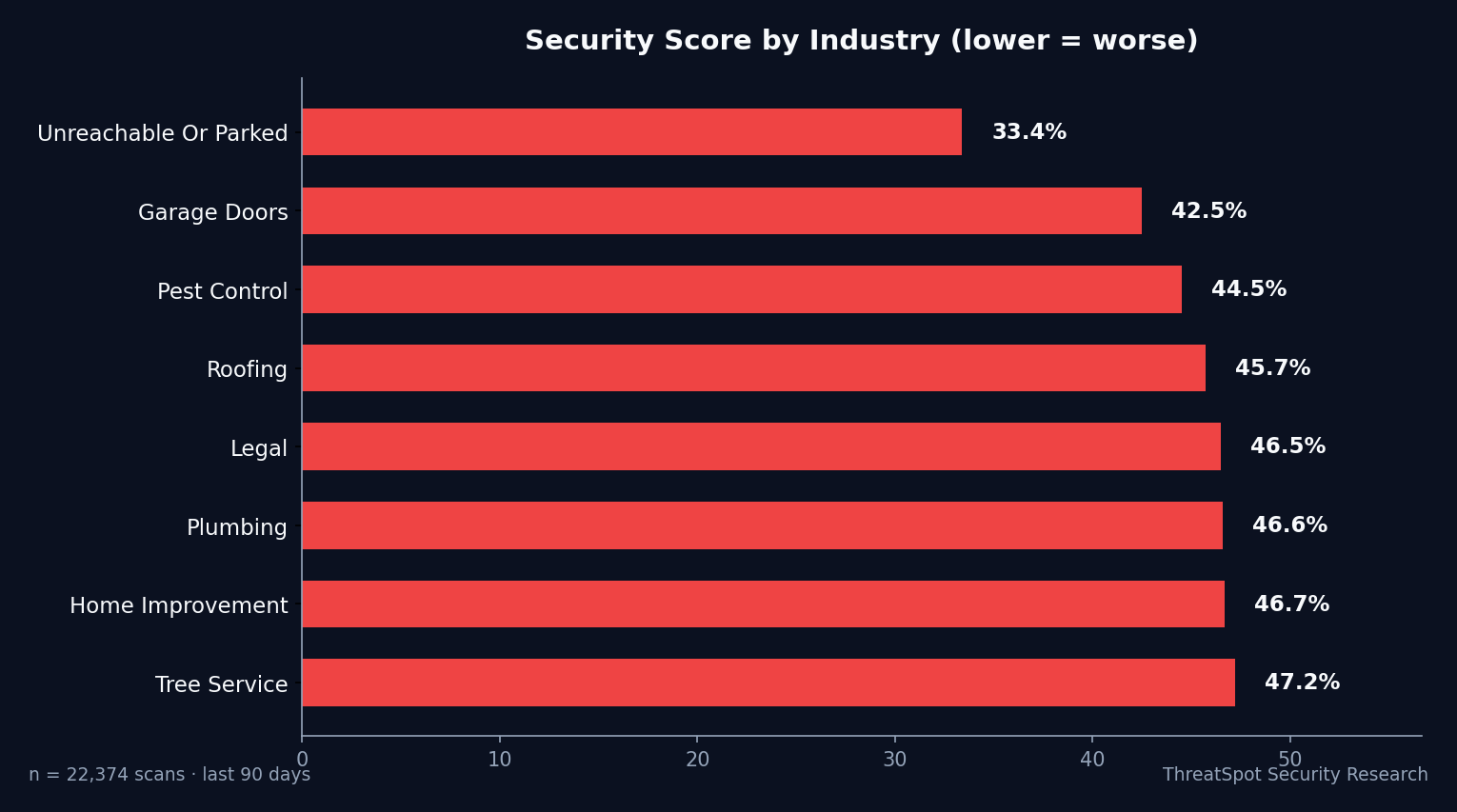
Out of the 35,345 scans across 32,290 unique small-business WordPress sites in the last 30 days, 87% failed to implement a complete set of standard security headers. Cookie security? Nearly everyone gets it right. But when it comes to headers, the industry flunks the basics at a staggering rate.
If you trust HTTPS alone, you’ve already lost. Hackers don’t care if your address bar says ‘secure’—one missing header exposes customer logins and payment details, and most small-business sites are wide open.
Key Takeaways
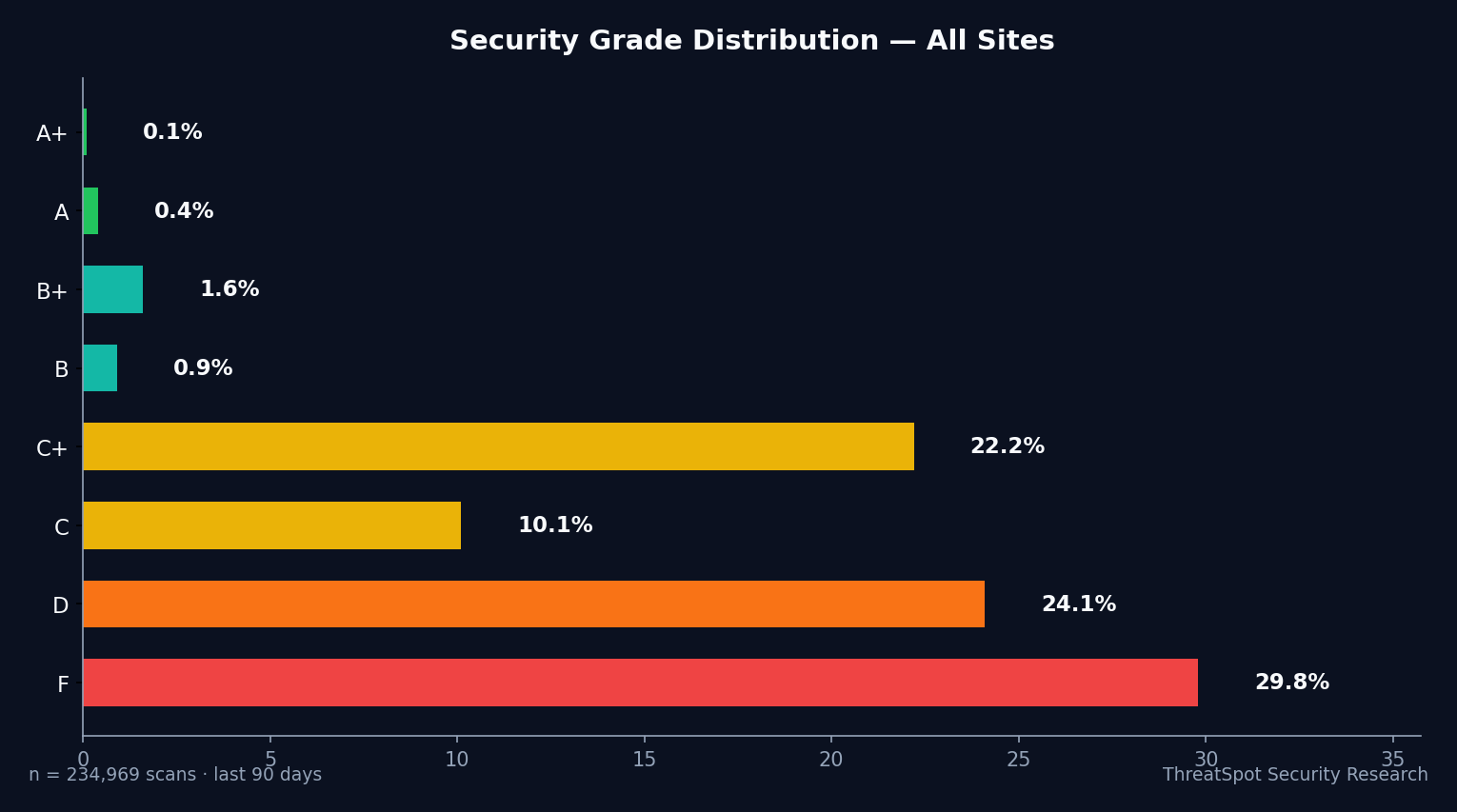
- 44.4% of WP sites scored an F on basic security checks
- Only 0.4% have all recommended security headers configured
- 68% are missing Content Security Policy entirely
- Cookie security is strong, but headers leave sites exposed
The Numbers
Across 35,345 recent scans, small-business WordPress security fails reveal a persistent pattern: HTTPS is nearly universal, but hardened SSL scores are rare, and security headers remain almost entirely neglected.
Grade Distribution (Last 30 Days):
| Grade | Sites | Percentage |
|---|---|---|
| A | 81 | 0.2% |
| B+ | 378 | 1.1% |
| B | 222 | 0.6% |
| C+ | 3,705 | 10.5% |
| C | 2,514 | 7.1% |
| D | 9,844 | 27.9% |
| F | 15,704 | 44.4% |
Four out of five sites never rise above a C. Security scan averages sit at a dismal 38.8%—more than half of checks fail.
Check Pass Rates:
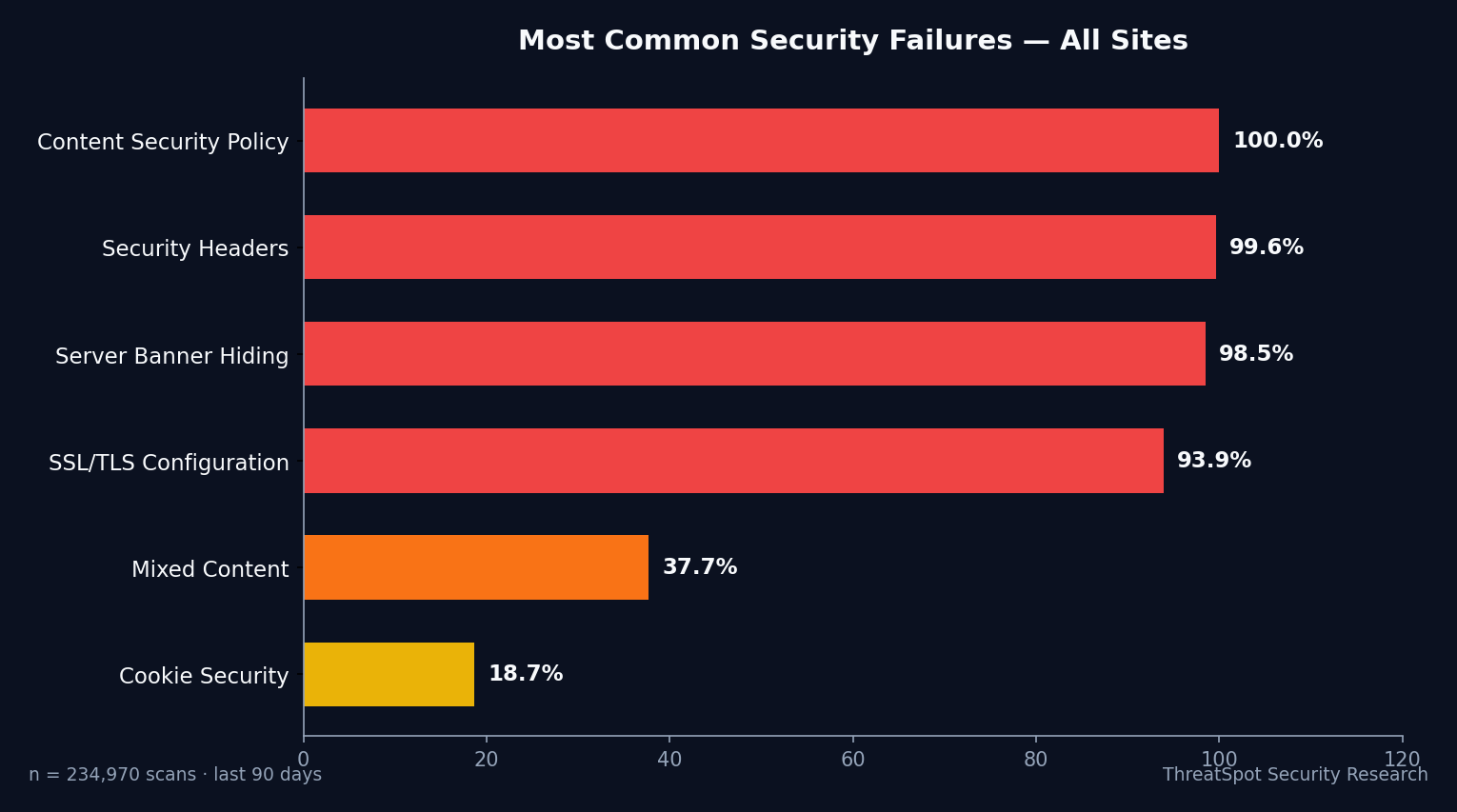
- SSL/TLS Configuration: Only 7.3% rated Good. This doesn’t just require an HTTPS cert. Sites need the full package: HSTS, modern TLS protocols, and strong ciphers. Most have basic HTTPS but miss advanced protections.
- Security Headers (all required): Only 0.4% rated Good. Full credit demands CSP, X-Frame-Options, X-Content-Type-Options, and Referrer-Policy—few even get half.
- Content Security Policy (CSP) only: 0.0% rated Good. Nearly every site fails the standard.
- Cookie Security: 87.6% rated Good. Secure flag, SameSite, and HttpOnly are nearly universal.
- Mixed Content: 71.9% rated Good. Most avoid insecure resources, but nearly 30% still blend secure and insecure content.
- Server Banner (no version leak): Only 1.4% rated Good. Exposing your exact server version puts a target on your back.
Server Version Disclosure: 20.7% of sites leak exactly which software version they run. This invites targeted attacks using known exploits.
How Small Business WordPress Sites Compare
Small business WordPress sites lag far behind best practices. Security headers—one of the lowest-cost, highest-impact defenses—see near-zero adoption outside the world’s most sophisticated companies.
Contrast that with cookie security: most small-business WP sites pass at rates rivaling large organizations. But the industry’s header adoption (0.4%) trails far behind even baseline security trends.
Large enterprises and regulated online retailers routinely deploy strong headers. Here, 87% of SMB sites miss even the minimum, often relying only on what their hosting provider set years ago.
This isn’t a theoretical gap. It’s one fixable today, yet left wide open month after month.
What This Means for Your Business
Failing to configure basic security headers leaves your entire site surface exposed to automated attacks that cost real money.
- Account Hijacking: Without a proper Content Security Policy, attackers inject code that steals passwords and session cookies. One misplaced script and you’re facing account hijacks or unauthorized purchases.
- Data Theft: Referrer-Policy gaps leak sensitive URLs—sometimes with coupon codes, cart contents, or internal admin links—straight to third parties.
- SEO Penalties: Google now penalizes sites with poor security hygiene or visible exploits. A single flagged page can tank your rankings for months.
- Lost Trust: Every customer expects the ‘secure’ padlock to mean their info is safe. Data leaks mean refunds, chargebacks, and public complaints.
A punch line for every founder: most shoppers never say a word if your checkout is unsafe—they just abandon the cart and never return.
What You Can Do Right Now
- Check your site’s headers using a reputable external security scan (never invasive, always legal).
- Add a strong Content Security Policy (CSP) header to your WordPress server or CDN.
- Enforce X-Frame-Options to prevent clickjacking—block your site from loading in external frames.
- Include the X-Content-Type-Options header to stop browsers from ‘guessing’ your file types.
- Set a strict Referrer-Policy to prevent leaking sensitive URLs.
- Review your site for mixed content; update all HTTP resources to HTTPS.
- Prevent server version leaks—hide or remove the server software version from all responses.
- Schedule automated site scans to catch missing headers or new vulnerabilities every week.
For a checklist of what to fix first, check our guide on quick security wins.
Final Thoughts
44.4% of small-business WordPress sites score an F on basic security—and 68% never even deploy the core security header that blocks code injection and data leaks.
Missing headers aren’t a harmless oversight. They’re an open door for automated attacks and instant lost revenue.
Run your site. See your security grade. Fix what fails—before your customers spot it before you do.