But the numbers paint a very different picture. In a sample of 1,341 security scans across 1,043 finance WordPress sites, 667 landed in D or F territory—nearly half failed the most basic security standards. Just 1.6% had strong browser security headers in place. These rates are not only below industry benchmarks—they reveal avoidable risks that directly threaten trust, uptime, and regulatory standing.
It’s time to challenge the myth that finance WordPress sites fly under the radar.
The Myth
Finance professionals and small business owners frequently assume their WordPress sites are inherently low-risk targets. Why? The logic runs deep: payment processing happens on Stripe or PayPal, not locally. Sensitive data stays elsewhere. Finance brands also tend to project more authority and security-consciousness, so owners believe attackers will look elsewhere for easier wins.
This perception seems rational given the workflow, but it glosses over a core reality: surface-level trust cues and off-site transactions don't block automated attacks, nor do they close off the web’s most common weaknesses.
The Data
We tested 1,341 finance WordPress security scans representing 1,043 unique small-business finance sites over the past 90 days. Each scan covered the site’s browser-facing security posture: SSL configuration, security header adoption, cookie settings, mixed content exposure, and server disclosure.
Key findings:
- 49.7% of all finance WordPress scans (667/1,341) received a D or F grade.
- Only 1.6% scored well for browser security headers—a critical mitigation for phishing, clickjacking, and active script attacks.
- SSL/TLS controls rated "Good" in just 10.1% of finance scans, well below the ~95% HTTPS adoption benchmark.
- 83.3% passed basic cookie security flag checks, but crucial protections like Content-Security-Policy (CSP) were present on just 0.1%.
- Industry average security score: 50.8%. Pass rate for grades A/B: 8.6%.
This group is far from a low-risk outlier. The typical finance site is on par with small law offices, HVAC vendors, real estate brokerages, and below online retail sites.
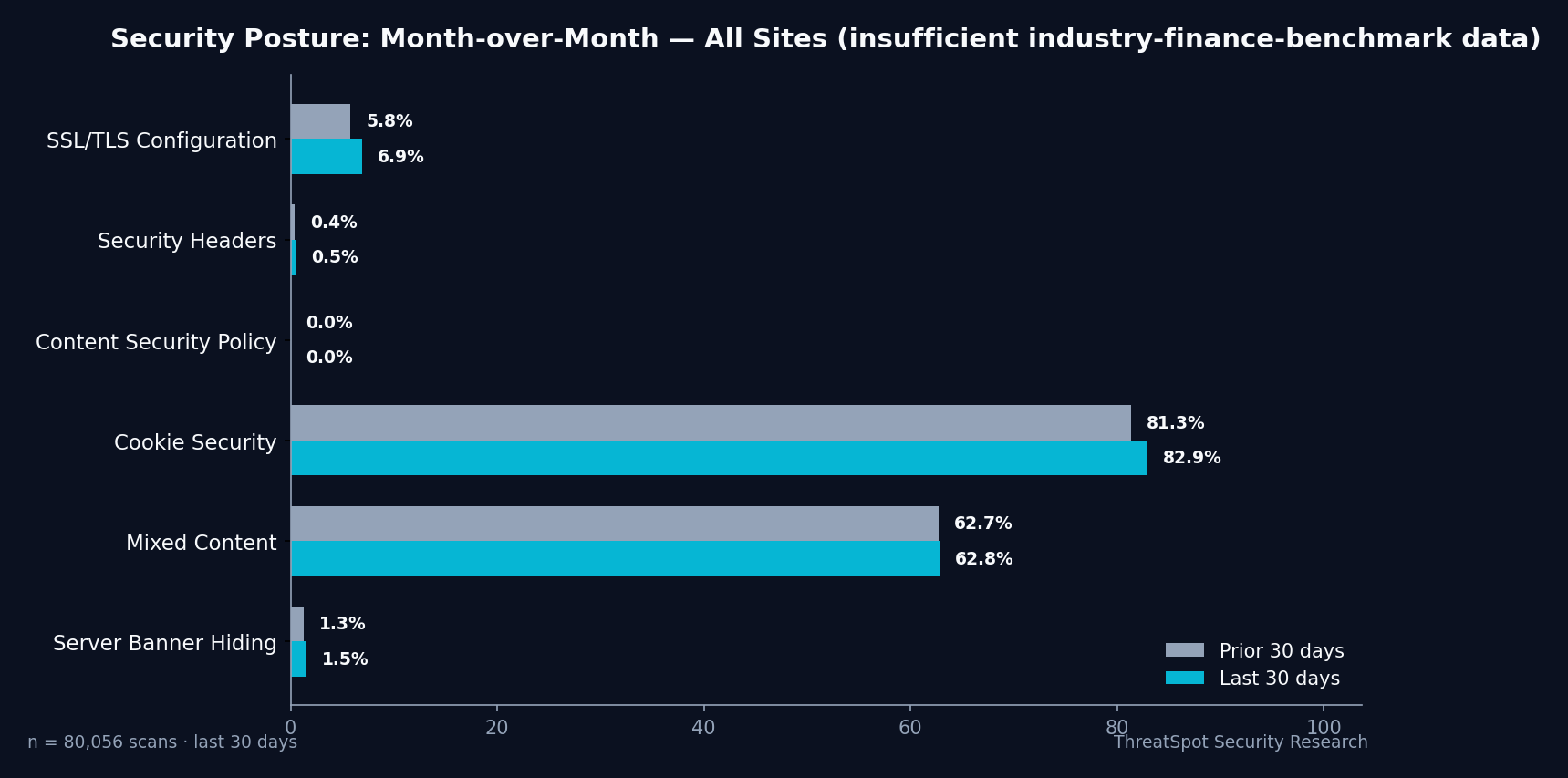
The Breakdown
Myth: "Finance sites are hardened by default—they handle money."
❌ Myth: Finance WordPress sites are hardened by default because they represent money.
✅ Reality: 49.7% of all finance WordPress security scans failed even basic browser-side checks.
Data: Of 1,341 finance site scans, only 115 rated an A or B. Most landed at C+ (24.3%), D (23.7%), or F (26.0%).
Business consequence: A "finance" label does not inherently push owners to configure extra security controls. Weak SSL, missing headers, and poor server disclosure all increase regulatory and SEO risk.
Myth: "As long as payment processing is outsourced (e.g., Stripe, PayPal), the site is low risk."
❌ Myth: Off-site payment handling means minimal security worry for the main site.
✅ Reality: Most attacks on finance WordPress sites target forms, scripts, vulnerable plugins, and insecure browser environments—not the payment processor itself.
Data: 98.4% of finance scans failed browser security header checks (e.g., X-Frame-Options, CSP). These gaps enable phishing overlays, fake login pages, and cross-site scripting attacks—potentially intercepting or spoofing payment flows.
Business consequence: Even if you never touch a credit card, misconfigured browser protections affect customer data, lead capture, and trust signals during shopping or onboarding.
Myth: "Finance sites have above-average security compared to other industries."
❌ Myth: Finance WordPress platforms rate above the SMB average for security.
✅ Reality: Finance ranks #30 of 43 scanned industries, tied with dental and trailing manufacturing, education, retail, and nonprofits.
| Industry | Average Score | Rank (out of 43) |
|---|---|---|
| Retail | 51.2% | 29 |
| Nonprofit | 51.2% | 28 |
| Manufacturing | 53.4% | 1 |
Business consequence: Finance WordPress sites lag behind competitive sectors. Visitors and clients—accustomed to strong bank-level protections—may notice the difference.
Myth: "SSL is the main thing that matters for finance website security."
❌ Myth: A padlock (HTTPS) alone is the security benchmark for finance WordPress sites.
✅ Reality: Only 10.1% of finance scans showed "Good" SSL/TLS posture. Benchmark studies show HTTPS presence ~95%, but strong configuration (correct redirects, legacy protocol disablement, secure cipher order) is the main driver of browser trust.
Data: The 10.1% strong SSL/TLS rate is based on configuration depth, not just HTTPS presence. Most sites fail to enforce 301/302 redirects or carry the HTTP Strict-Transport-Security (HSTS) header—key to defending against downgrade attacks.
Business consequence: Missing advanced SSL rules can lead to browser warnings or lost conversions, undermining client confidence.
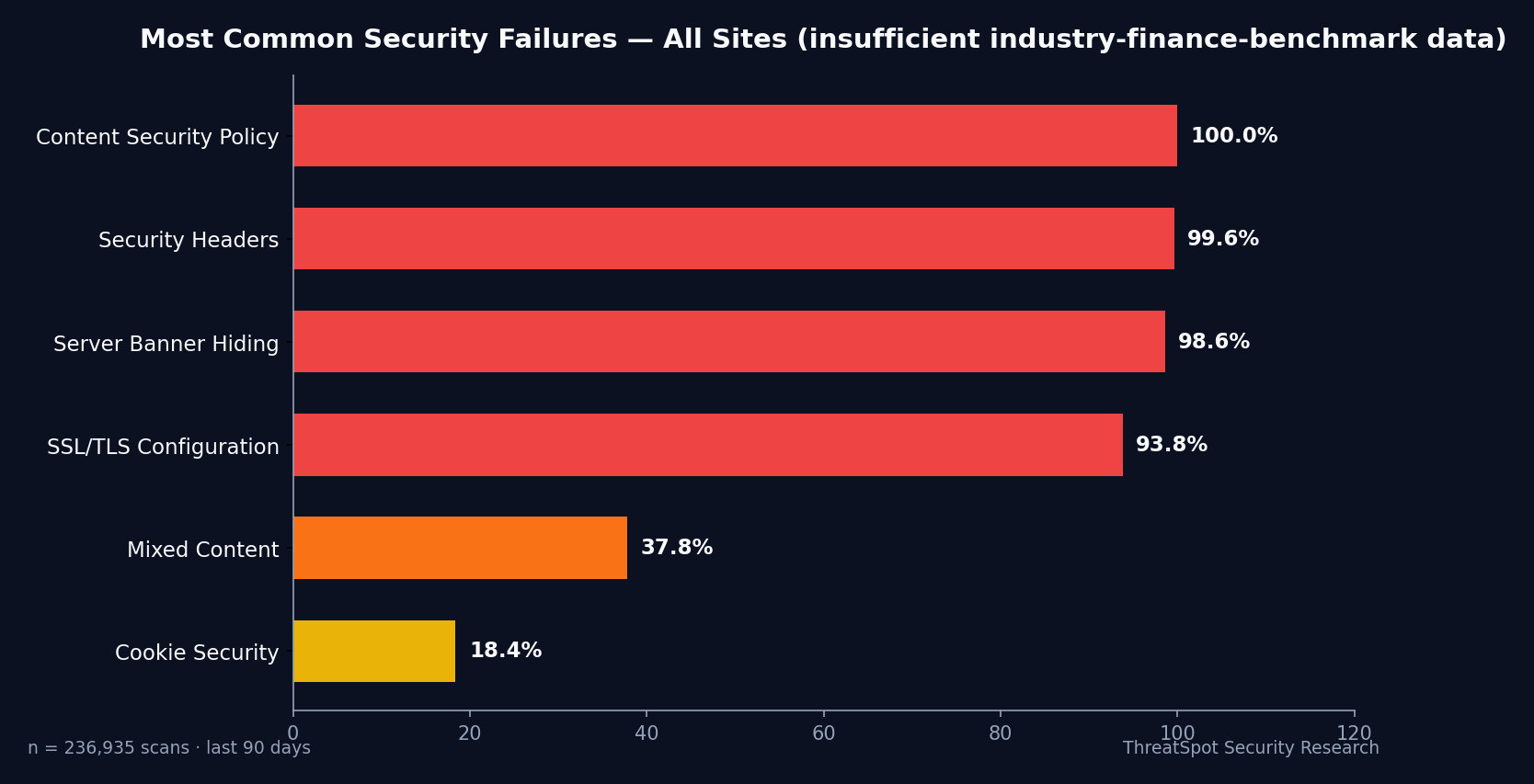
What to Do Instead
Use this checklist to establish real risk boundaries—regardless of whether you handle payments directly:
| Checkpoint | What to Expect | How to Address |
|---|---|---|
| SSL/TLS configuration | Only 10.1% pass | Go beyond simple HTTPS. Test for forced redirects, legacy protocol blocking, HSTS. Use tools like SSL Labs and automated scanners for validation. |
| Content-Security-Policy (CSP) | 0.1% pass | Set a sitewide CSP to restrict script sources and cut off opportunistic JavaScript attacks. Use staged deployment with monitoring in case of disruption. |
| Cookie security flags | 83.3% pass | Ensure all authentication and session cookies are marked Secure, HttpOnly, and SameSite=strict if possible. |
| Visible server banners | 95.4% disclose details | Remove or obscure public server/version banners via server settings to reduce automated recon. |
To immediately understand where your finance WordPress site sits within sector risk norms, run an automated website security scan. This checks browser security posture without risking downtime or data access.
Final Thoughts
Nearly half of all small business finance WordPress sites scanned in the past 90 days failed basic browser-facing security standards. Only 1–2 in 100 actually pass strong security header or SSL configuration checks, placing them well below sector benchmarks.
The myth that finance WordPress sites are inherently safer—or less interesting for attackers—is disproven by the data. Surface-level trust signals and outsourced payments do not close the loop on browser or plugin security. In most cases, the core gap is configuration—often fixable with a handful of targeted steps.
Don’t let a "finance" label lead to a false sense of digital security. Start with a no-download, passive security scan and compare your site’s grade to sector peers. Mitigate what you can, document fixes, and repeat scans quarterly.
For practical improvements you can act on today, see our guide on quick security wins.
FAQ
Q: Isn’t my site safe if I don’t process payments directly?
No—browser-level vulnerabilities can lead to trust issues, lost leads, and social engineering attacks that mimic bank flows, even if card data never passes through your site.
Q: How does my site’s score compare to other industries?
Finance sites tie with dental and rank #30 out of 43 industries scanned (average security score: 50.8%). Retail and nonprofit both outpace finance on average.
Q: What is the single biggest gap to fix first?
Add missing browser security headers and review your SSL/TLS configuration. These have the largest impact on trust, browser safety, and fraud prevention.
For more on non-intrusive, ethical scanning, read our safe scanning policy.