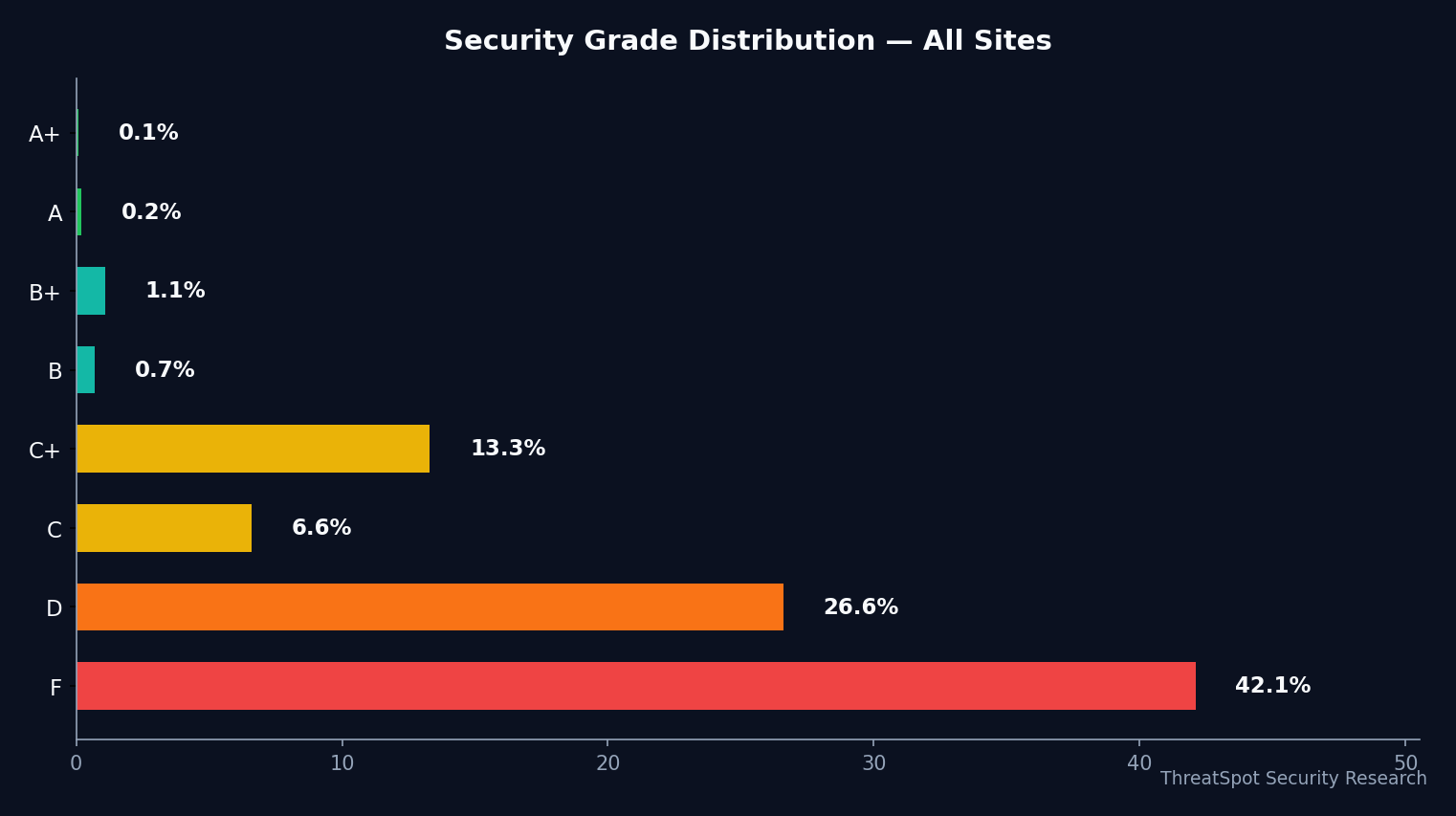
We analyzed 3,301 security scans across 2,071 healthcare WordPress sites over the past 90 days. The results are direct: 2,194 of those scans—66.5%—landed in D or F grades. Measured against 44 other industries, healthcare sits just above the median but reveals sharply defined weaknesses, especially around missing browser-level defenses and encryption standards.
Key Takeaways
- 66.5% of healthcare WordPress scans fell into failing (D/F) categories—nearly identical to less-regulated sectors such as roofing or e-commerce.
- Only 0.6% of healthcare sites scored well on security headers—a critical browser defense—while 91.3% failed SSL/TLS configuration checks.
- Healthcare outperforms most peers on cookie security (89.7% rated "Good") but lags on foundational controls such as Content-Security-Policy and HSTS.
The Contenders
Healthcare
Size: 3,301 scans | 2,071 unique WordPress sites
Profile: Physician offices, clinics, medical practices, dental/vision centers, and therapy networks; mostly US-based, with additional footprint in Germany, the UK, and North America.
Stack: Predominantly core WordPress with minimal plugin customization; heavy reliance on themes or all-in-one plugins for content delivery.
Risk Profile: Handles appointment scheduling, contact forms, and location search—often with sensitive PII at risk if breached. Regulatory pressure (HIPAA in the US, similar abroad) makes reputation and continuity critical, even when no PHI is stored site-side.
Other Industries
3,301 healthcare sites were measured against 44 industry segments—including manufacturing, finance, legal, government, and e-commerce.
Typical Sites: Large agencies, independent local businesses, professional service firms, and non-profits.
Threat Landscape: Ranges from pure lead-gen to complex e-commerce, with widely varying compliance needs. Manufacturing and retail sectors routinely edge out healthcare on raw security score.
Head-to-Head Comparison
How does healthcare stack up on major WordPress risk signals compared to the industry average and known benchmarks? This table summarizes the key metrics.
| Metric | Healthcare | All Industries<sup>1</sup> | Public Benchmark<sup>2</sup> | Winner |
|---|---|---|---|---|
| Failing (D/F) Grades | 66.5% | 63-68% (typical) | – | – |
| SSL/TLS Good | 8.7% | 10–15% (est) | 95% HTTPS<sup>a</sup> | Industry Avg |
| Security Headers Good | 0.6% | 1.5–4% (avg) | 4–6% (all headers)<sup>b</sup> | Industry Avg |
| Cookie Security Good | 89.7% | 80–85% (avg) | – | Healthcare |
| Mixed Content Good | 73.0% | 70–75% (avg) | – | Healthcare |
| Server Banner Good | 1.6% | 2–3% (avg) | – | Industry Avg |
<sup>1</sup> Estimated from industry scan averages (see source table below)
<sup>2</sup> Chrome Transparency Report 2025; Scott Helme Security Headers Survey 2025
<sup>a</sup> Note: their figure measures HTTPS presence, not advanced SSL/TLS config
<sup>b</sup> All recommended headers, not a single one
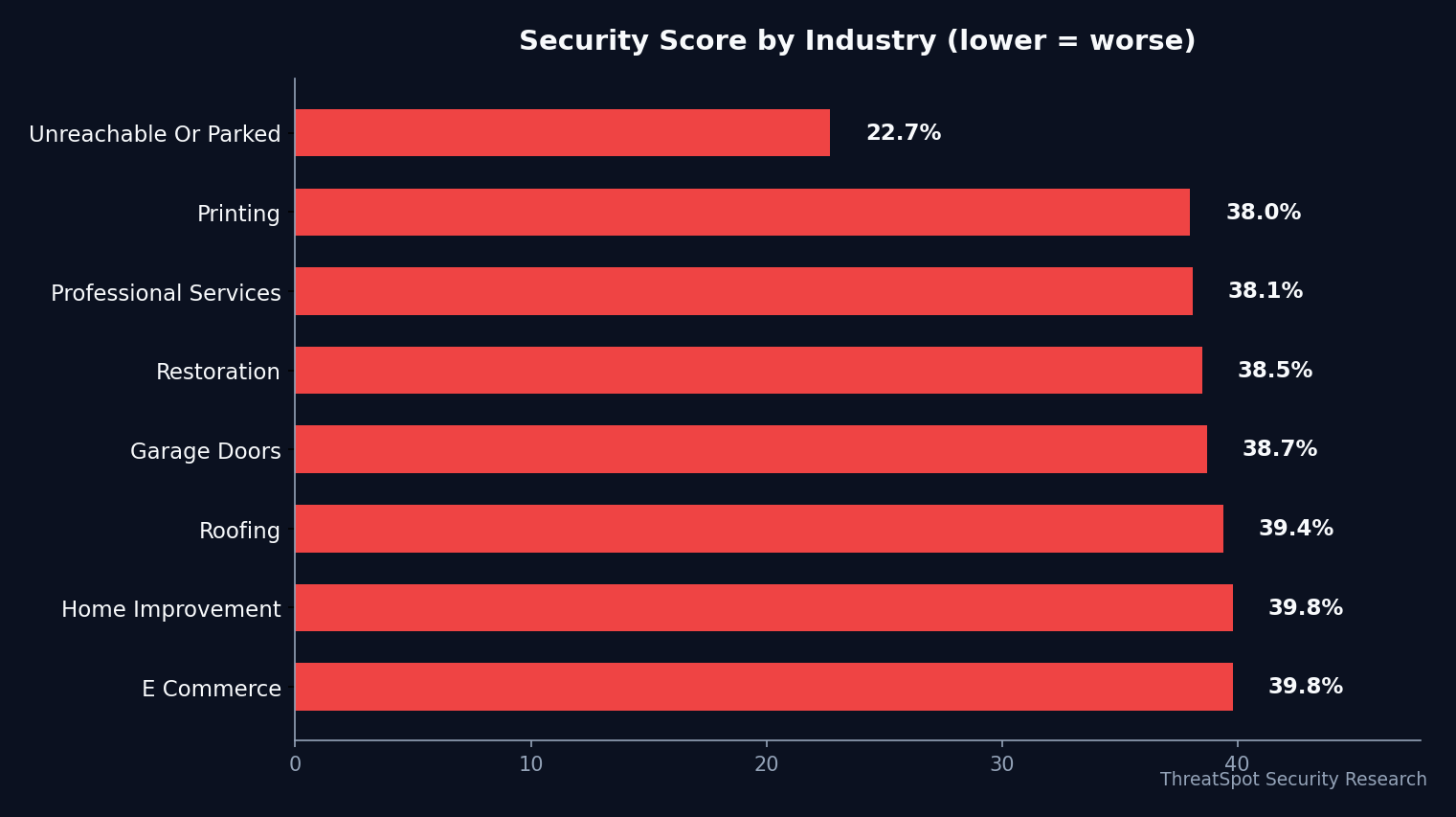
Where Each Industry Struggles
Healthcare’s Biggest Weakness: Header Hygiene
In our sample, only 0.6% of healthcare sites scored “Good” for security headers, versus even the modest 4–6% public average for all recommended headers. Content-Security-Policy (CSP) protection was absent on every healthcare site surveyed (0.0%).
This gap matters. Security headers defend against browser-based attacks such as clickjacking, cross-site scripting (XSS), and data leakage. For healthcare, where appointment forms and email inquiries are common, these missing headers expose avoidable risk pathways—even if no medical records are directly at stake.
Key context: CMS-driven SMB websites rarely achieve strong header scores out-of-the-box. Still, virtually total absence (0.6% passing) signals pervasive neglect—not simply a technical challenge.
Other Industries: SSL/TLS and Outdated Software
Across all segments, advanced SSL/TLS configuration remains a sore spot. Healthcare’s 8.7% pass rate for SSL/TLS is actually slightly below the low industry norm for SMBs (10–15%), and far below the 95%+ marker for baseline HTTPS presence on the public web.
Government, legal, and professional services lag on plugin updating and core WordPress patching—leaving them vulnerable to attack chains that exploit known CVEs (see OWASP Top 10). For reference, almost half of WordPress sites run an outdated core (Patchstack 2024), while 97% of all known WP vulnerabilities are plugin-related.
Why the Differences Exist
Healthcare sites are overwhelmingly built quickly, from pre-made themes and basic templates, often by non-specialist vendors or local designers. The focus is visual branding, not layered security. Site managers rarely revisit configuration after initial launch, leading to missed critical updates—especially for browser-facing controls that aren't visible to the naked eye.
Other sectors—like manufacturing or retail—often engage agencies with deeper devops integration, or are simply more likely to run recent stacks with better default controls. But across the board, SMB sites are not achieving modern security hygiene without proactive scanning and remediation.
What Both Can Learn
Universal Lessons:
- Security headers are not optional. Even a basic X-Frame-Options or X-Content-Type-Options header can block common browser-based exploits. Low pass rates (0.6% in healthcare) show an urgent opportunity for easy, high-value wins.
- SSL/TLS must go beyond “green padlock.” Most failings relate to insecure protocols, weak cipher suites, or absent HSTS. Automated configuration checks are essential to illuminate these gaps.
- Mixing content from insecure origins creates exposure. At least 27% of healthcare scans flagged this—users may see a lock icon, but browsers and search engines penalize mixed resources.
- Cookie security is the one bright spot. 89.7% “Good” stands out, but this only helps if other application-layer controls are in place.
- Automated scanning closes the knowledge gap. Continuous, outside-in scanning surfaces issues site owners would otherwise never see—from stale headers to exposed server signatures.
For actionable improvements, review the 5 fast fixes in our post: Quick Wins to Improve Your Website Security.
Final Thoughts
Healthcare WordPress sites, despite handling sensitive functions, see 66.5% of security scans fail basic security hygiene. While this mirrors the SMB sector more broadly, the reputation and operational risks in healthcare make these gaps worth immediate remediation—not just checkbox compliance.
Automated scanning and actionable dashboards help site owners quickly surface browser, server, and application misconfigurations. Where manual review falls short, regular outside-in scanning highlights what patients and attackers really see.
What You Can Do Right Now:
If you manage a healthcare website—or oversee WordPress portfolios across any industry—the fastest route to improvement is to run a website security scan. It takes only a moment to get a tailored action list. Start your scan today and use your results to drive updates, even if you’re not a technical pro.
FAQ
Is failing a scan the same as being hacked?
No. Failing grades mean gaps in best practices—not an active compromise. But the same weaknesses are often targeted first in real-world attacks.
What’s the easiest fix for a low grade?
Set security headers and confirm SSL/TLS configuration. Many fixes require just a line of code or plugin setting—but you must know what’s missing.
Why is my SSL/TLS score so low if my browser shows a padlock?
Basic HTTPS is necessary, but modern scanners test for protocol strength, certificate validity, and HSTS enforcement. A visible padlock alone doesn't guarantee strong encryption.
How often should sites be scanned?
Monthly at minimum, but ideally after any code, plugin, or vendor change.
Sources:
Chrome Transparency Report 2025, Scott Helme Security Headers Survey 2025, Patchstack State of WordPress Security 2024, Sucuri Website Threat Research Report 2024
- Industry averages calculated from 44 segment scan averages shown above.
- Public benchmarks as cited in table.
- For more, consult our FAQ and recent blog posts.