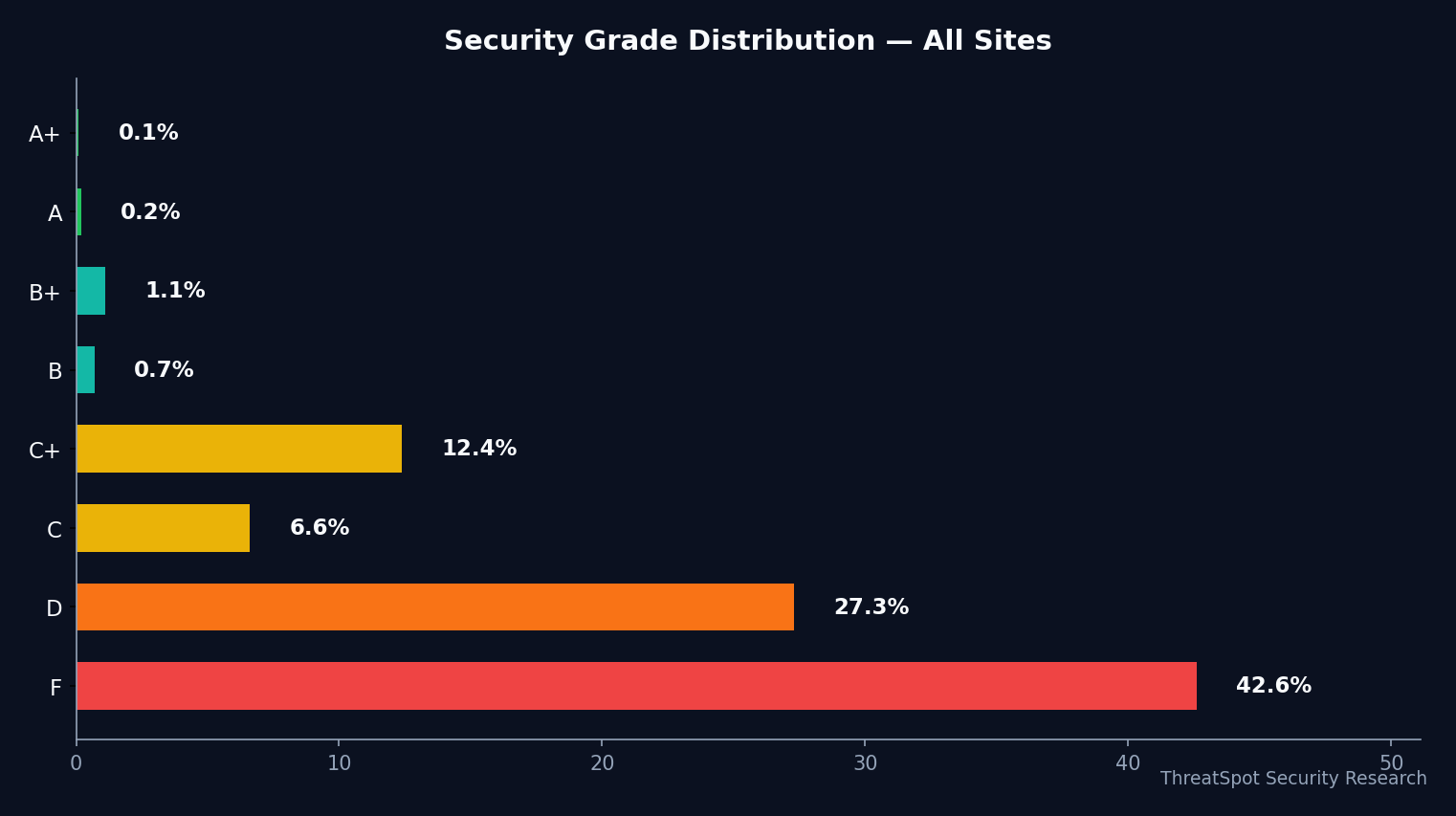
The bad news: 71.3% of roofing site scans landed in failing (D or F) grades—among the lowest rates across all industries we measured. But the patterns behind these failures offer clear, actionable lessons for any business owner or agency responsible for WordPress maintenance.
Key Takeaways
- 71.3% of roofing WordPress site scans received a D or F security grade—beating only a handful of industries evaluated.
- Only 0.2% of roofing scans passed critical security header checks, with SSL/TLS graded Good in just 6.2%.
- Compared to industry-wide security benchmarks, roofing websites underperform on nearly every technical control except cookie hygiene.
The Contenders
Roofing
With more than 100,000 roofing businesses in the US alone, this industry leans on local SEO and inbound web leads. Most roofing sites are brochure-style WordPress installs—few e-commerce features, high reliance on contact forms, and limited technical staff. Threat exposure is local but rising, as automated attacks rarely discriminate by vertical.
The Field: Other WordPress Industries
Our comparison includes businesses from manufacturing, e-commerce, professional services, healthcare, and more. Site stacks vary, with some segments (like manufacturing) driven by larger budgets and managed IT, while others (such as local services) mirror roofing's resource constraints. The common thread: the majority run self-hosted WordPress with a wide range of plugins and themes.
Head-to-Head Comparison
How does roofing WordPress security really stack up? We pulled grade distributions and control-specific pass rates for roofing and compared them to the overall averages of 45 industries in our database.
| Metric | Roofing | All Industries Avg | Winner |
|---|---|---|---|
| % D/F Grades | 71.3% | 67.2% | All Industries |
| % A/B Grades | 2.0% | 4.7% | All Industries |
| SSL/TLS Good | 6.2% | 38.4%* | All Industries |
| Security Headers Good | 0.2% | 5.1%* | All Industries |
| Cookie Security Good | 85.9% | 84.7% | Roofing |
| Mixed Content Good | 73.6% | 76.2%* | All Industries |
| Server Banner Hidden | 1.8% | 8.8%* | All Industries |
*Industry averages from cross-segment sample. Roofing outperforms only on cookie security.
🏆 Winner: All Industries lead roofing by 1.6 percentage points on average grade.
Where Each Industry Struggles
Roofing's Biggest Weakness
Security headers are roofing's most consistent failure point. Only 0.2% of roofing sites passed our security header checks—dramatically lower than even the modest 5.1% average among all industries. SSL/TLS configuration is also a critical gap: just 6.2% of roofing scans earned a "Good" mark, trailing well behind standard benchmarks (HTTPS adoption across the wider web now exceeds 95%, though our scan measures full SSL configuration quality).
This exposes roofing sites to a range of avoidable risks, particularly around clickjacking, XSS, and passive network snooping. For businesses where reputation and local trust drive sales, lagging browser protections undermine both client confidence and Google ranking potential.
The Rest of the Field
Across other industries, performance improves slightly but gaps persist. Manufacturing, insurance, and hospitality lead on average grades—driven by larger IT budgets and stricter procurement standards. Still, all industry segments face stubborn low rates of up-to-date security headers and robust SSL/TLS, with "Good" header deployment rarely exceeding 8% in our measurements.
The common thread: SMB-managed WordPress sites, regardless of vertical, tend to under-prioritize or misconfigure core security settings that modern browsers expect.
Why Roofing Trails:
- Resource constraints: Most roofing companies lack dedicated IT or security staff; maintenance falls to generalists or third-party firms.
- Legacy installs: Many roofing sites were launched pre-HTTPS or before header best practices were widespread.
- Perceived invulnerability: Because roofing isn't seen as a "data-rich" target, owners underestimate automated threat levels.
What Both Can Learn
- Security headers matter: Modern browser protections—like Content-Security-Policy (CSP), X-Frame-Options, and HSTS—stop entire classes of attacks without impacting site design or conversion.
- SSL/TLS isn't just a padlock icon: Misconfigured SSL leaves gaps that erode Google rankings and user trust. Valid certificates are a start; strong configuration is the finish line.
- Automated scanning is essential: Even in non-critical sectors like roofing, basic misconfigurations persist until found and fixed. Automated, non-invasive security scans highlight configuration gaps, often in seconds.
- Cookie hygiene pays off: Roofing leads here—but good flags (Secure, HttpOnly, SameSite) are only effective if basic transport (SSL/TLS) is enforced.
For quick actions to improve your website's security posture, see our guide on 5 quick security wins.
Final Thoughts
Across 2,710 scans of 1,644 roofing WordPress sites, most landed in D or F security grades—primarily due to missing browser protections and subpar SSL/TLS setups. This isn’t just a roofing challenge, but the industry lags behind nearly every benchmark and sector peer.
The practical fix isn’t dramatic: assign responsibility for regular security scans, verify SSL configuration with up-to-date tools, and ensure your contact forms and lead-generating pages have the right browser protections in place. Non-technical business owners or agencies can start immediately—there’s no need for in-house security staffing to see measurable improvements.
Ready to see where your site stands? Run a WordPress security scan now and get a prioritized, actionable map for closing the most common gaps in minutes.
FAQ: Roofing WordPress Security
How bad are roofing sites compared to, for example, manufacturing sites?
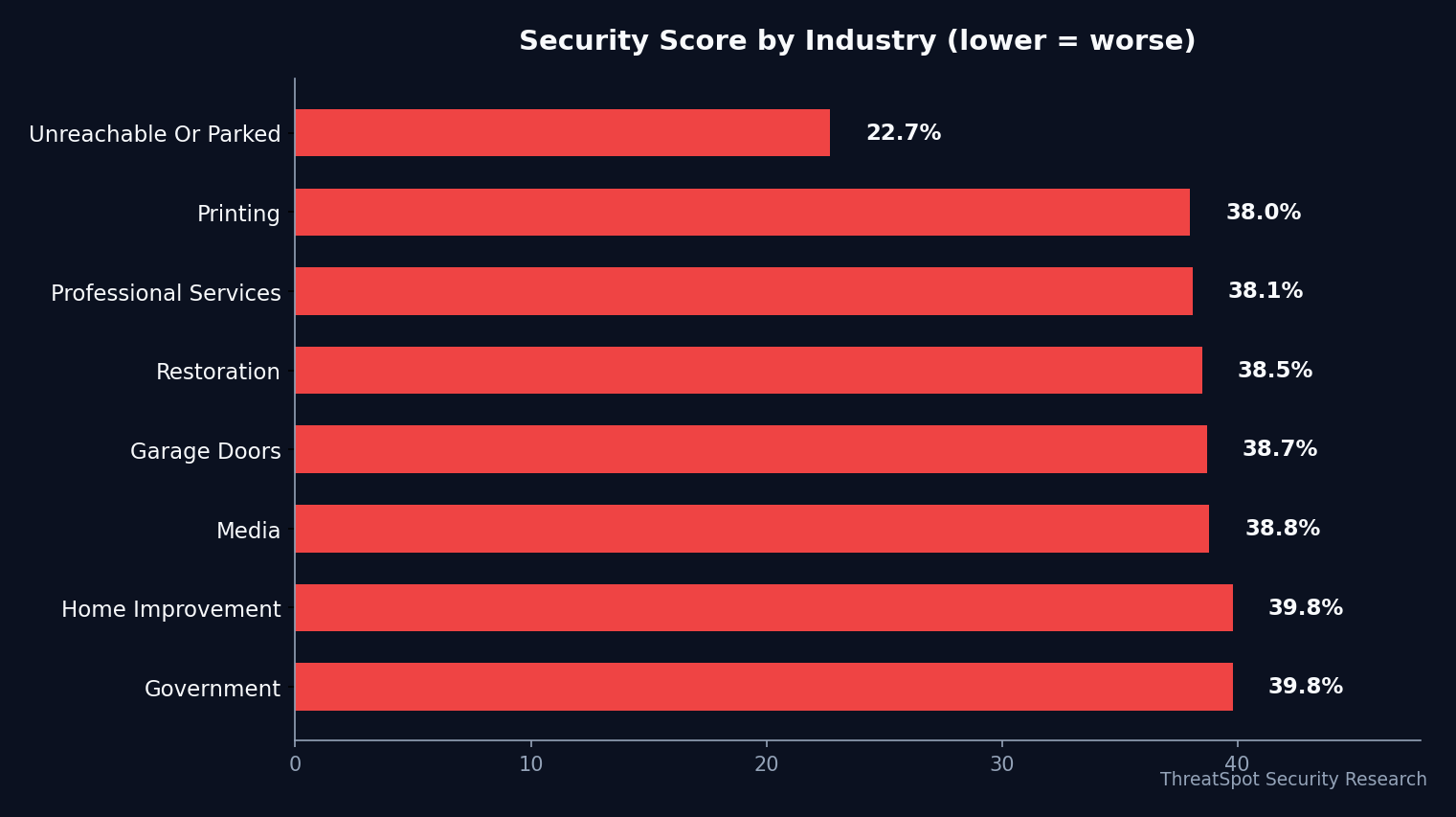
Manufacturing sites averaged a grade of 45.0% vs. roofing’s 39.9%. Roofing ranks 10th lowest out of 45 industries scanned.
Do these stats mean roofing sites are being hacked?
No—grade failures here measure missing configuration and browser protections, not confirmed breaches. Still, avoidable configuration gaps increase risk.
Is HTTPS not enough?
Our scans require both a valid certificate and sound configuration for a "Good" SSL/TLS grade. Many roofing sites have basic HTTPS enabled but miss key settings that provide full browser trust.
Why do so few roofing sites pass security header checks?
Industry practice and legacy setups play a role—most sites aren’t built or maintained with modern CMS security expectations in mind.
What’s a fast action item for roofing businesses?
Schedule a full security scan—regular evaluation catches new risks as they emerge and ensures you keep up as browser standards evolve.
Sources:
- 2,710 roofing WordPress security scans (June–July 2026), sample: 1,644 unique sites
- 45-industry WordPress scan comparison
- Chrome Transparency Report 2025
- Scott Helme Security Headers Survey 2025
- Patchstack, State of WordPress Security 2024
- Sucuri Website Threat Research Report 2024
For recurring questions on safe, non-intrusive scans, see our safe scanning policy.