Dental practices depend on patient trust. This segment’s average security score of 39.6% ranks squarely in the lower half of all professional services websites, trailing verticals like manufacturing and even restaurants. For small practice owners, this isn’t just a technicality—it’s an avoidable risk to bookings, search rankings, and brand reputation.
Key Takeaways
- 68.3% of dental WordPress scans failed (D/F grades)
- Only 0.6% passed all recommended security header checks
- Dental sites scored below standard WordPress security benchmarks
- Gaps in browser encryption and cookie protection remain routine
The Numbers
These findings are based on 7012 automated security scans of 3984 unique dental WordPress sites performed over the past 90 days. Each scan evaluated public-facing configurations: HTTPS, TLS, security-relevant HTTP headers, cookie flags, mixed content handling, and server metadata.
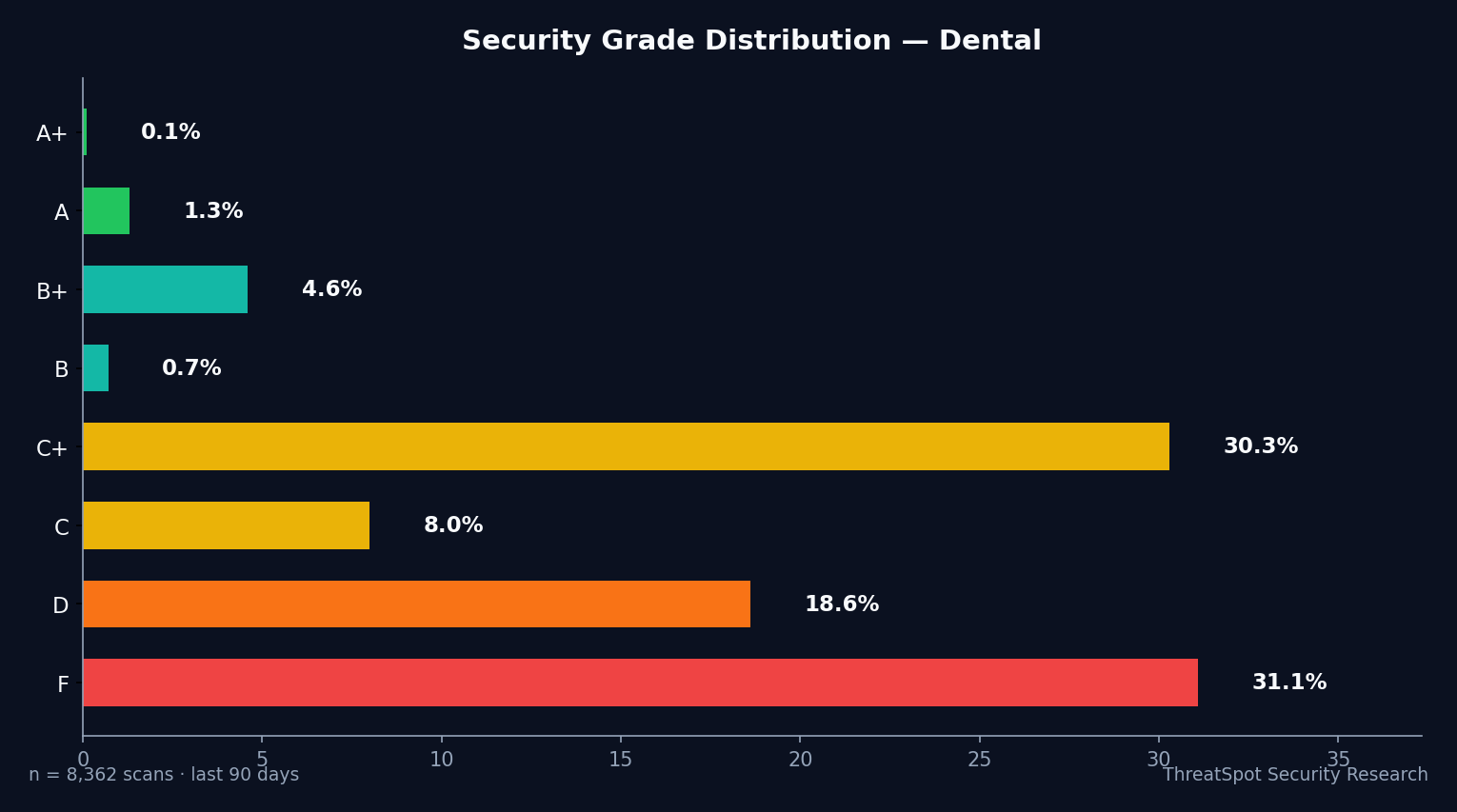
The grade distribution offers a clear view:
| Grade | Site Count | Percentage |
|---|---|---|
| A | 35 | 0.5% |
| B+ | 105 | 1.5% |
| B | 58 | 0.8% |
| C+ | 816 | 11.6% |
| C | 480 | 6.8% |
| D | 2004 | 28.6% |
| F | 2785 | 39.7% |
📊 4789 of 7012 dental site scans (68.3%) landed in D or F range.
Security Check Failure Rates:
- Security headers were the single strongest negative driver—99.4% failed this check.
- Full SSL/TLS configuration met modern standards in just 6.9% of scans, much lower than overall HTTPS adoption rates.
- Cookie security was the highest performer: 89.7% passed.
- Mixed content (unsafe asset loading) was properly handled 78% of the time—still leaving 22% with avoidable exposure.
- Exposed server banner metadata (which can tip off attackers) was present on 99.2% of sites.
Notable plugin findings: No plugin was strongly over-represented among failing sites. Common plugins like Elementor, Contact Form 7, and Site Kit appeared only once each.
The United States accounted for the largest share of sites (4611), followed by Germany (485), the UK (234), Australia (164), and Japan (125). Sites across all geographies exhibited similar patterns of missing security protections.
How Dental Websites Compare
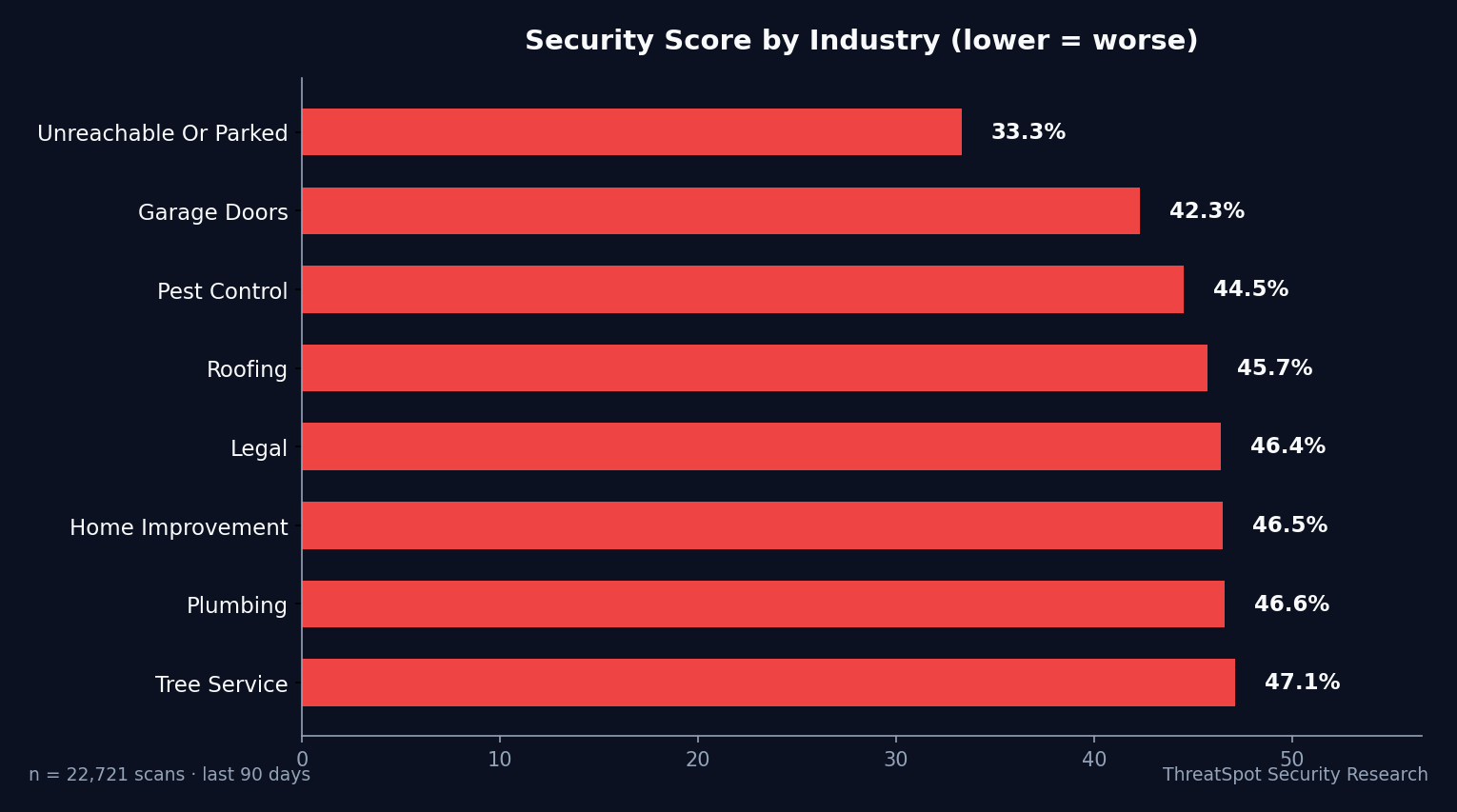
Dental WordPress sites are not the weakest performers overall, but their average grade of 39.6% ranks middle-to-low across 45 tracked industries:
| Industry | Avg Security Score (%) |
|---|---|
| Hospitality | 43.2 |
| Insurance | 43.1 |
| Dental (this scan) | 39.6 |
| Beauty | 38.4 |
| Printing | 37.7 |
| Unreachable/Parked | 24.3 |
Industry context:
- Manufacturing (top): 43.9%
- Dental: 39.6%
- Printing (lower tier, SMBs): 37.7%
- Unreachable sites (lowest, not live): 24.3%
Dental websites score slightly below aggregated WordPress security benchmarks, which is consistent with other professional service verticals but lags behind specialized B2B sectors.
Why so low?
- This assessment measures not just HTTPS presence, but full SSL/TLS configuration (not achieved by 93.1% of sites).
- Security headers, common in enterprise, remain rare in small business practices.
- Compared to Chrome’s report of ~95% HTTPS adoption globally, only 6.9% of dental scans met modern SSL/TLS standards in this test.
- Only 0.6% of dental sites passed all key security headers, compared to 4–6% in broader surveys (Scott Helme, 2025).
What This Means for Your Business
Why it matters:
Missing security headers and incomplete HTTPS setup aren't signs of an instant hack, but they weaken the browser shields that protect both patients and practice staff. Here’s how this impacts dental site operators:
1. Lost patient trust: Even a browser warning about mixed content or expired certificates can push a potential patient to another practice.
2. SEO risks: Google has directly confirmed that HTTPS is a ranking factor, and browsers label non-secure pages as “Not Secure.” Being flagged—even unintentionally—can lower organic reach.
3. Revenue loss from downtime: Security gaps aren’t always exploited, but automated scans targeting exposed sites can take pages offline or block payments, impacting bookings and follow-ups.
4. Compliance and insurance friction: While dental sites under HIPAA don’t necessarily store ePHI online, security review failures can complicate contractual requirements or cyber insurance renewals.
Most security gaps in dental WordPress setups are caused by misconfigured infrastructure or skipped best practices—not by actively hostile actions. These are avoidable, and remediation is usually non-disruptive if identified early.
What You Can Do Right Now
Empower your dental practice—even with limited technical skill—to make measurable improvements:
- Check your site’s SSL configuration. Test using a public scanner—ensure all browser warnings are resolved, not just “padlock present.”
- Activate all recommended security headers. Focus on HSTS, X-Content-Type-Options, and X-Frame-Options. Work with your host or developer if unclear.
- Review cookie flags. Confirm that cookies use Secure and HttpOnly flags; this is one area dental sites scored above average.
- Scan for mixed content. Make sure all images, scripts, and embeds load via HTTPS, especially after a migration or domain change.
- Minimize exposed server info. Remove or obscure “server banner” metadata to limit your attack surface.
- Regularly update WordPress core, plugins, and themes. This remains the leading risk area system-wide.
- Schedule recurring scans for website vulnerabilities. If you’re not sure what’s visible to attackers, regular scanning offers quick wins.
- Enforce user least privilege. Limit admin rights to essential users only, especially if you outsource updates.
For further details on practical security improvements, see our roundup of 5 quick wins to improve your website security.
Final Thoughts
Dental WordPress websites are not uniquely at risk, but they underperform basic security benchmarks: 68.3% of scans from 3984 dental sites failed baseline security grades, especially due to missing security headers and incomplete SSL/TLS. Most of these issues are configuration gaps, not evidence of compromise—but each gap increases long-term exposure for both patient bookings and online reputation.
You don’t need to be a technical expert to close these risks. Start by running a comprehensive website security scan and prioritize remediation of failing checks—it’s the fastest way to boost trust with patients and protect your search results before small gaps become costly issues.